A Tester For Zener Diodes

Zener diodes are used for several purposes, from providing a reference voltage, to protecting sensitive circuits from being destroyed by the wrong input.

Today, I will show you how these diodes work and how to build a simple circuit to measure their most important characteristic, the reverse breakdown voltage. To know more on this topic, please watch the companion video posted on YouTube.

A zener diode looks like a regular diode and actually behaves as such when directly biased (positive voltage on the anode).

However, when inversely biased (negative voltage on the anode), a zener diode behaves in a completely different way.

Let’s take a look at its characteristic I-V diagram:

zener_characteristic

You can see that in the region of direct (or forward) bias, the zener behaves just like any diode. It also seems like in the inverse bias it behaves like a regular diode.  However, there is a big difference between the two.

For a regular diode, the reverse breakdown voltage is very high, in the order of 100V or more, sometimes much more. Such high that you never think at it when you use regular diodes, and you assume that with inverse bias the diode just does not conduct electric current.

For a zener diode, instead, the reverse breakdown voltage is low, in the order of one or two digit volts. Therefore, it is very easy in an electronic circuit to bring this kind of diode to reach the condition when it will start conducing electric current even if inversely polarized.

We actually exploit this behaviour to create reference voltages, or to provide a protection against unwanted voltages at the input of certain circuits, or a ton of other things.

The behaviour of a diode depends in fact upon the way it was fabricated, and in particular upon how it was doped. Regular diodes are lightly doped, while zener diodes are heavily doped. Depending on the amount of doping on both the P and the N side of the junction, the reverse breakdown voltage changes. That way, manufacturers can create zener diodes within a large range of breakdown voltages.

Problem is, manufacturers often don’t put the value of the breakdown voltage on the body of the components. Instead, they put some internal code or, sometimes, nothing at all.

So, if you had a number of such diodes on your workbench, how to distinguish them from one another?

Meet the zener tester.

It is a device that allows you to measure the reverse breakdown voltage, so you know if the diode works and what that voltage is.

How such a tester works? From the I-V diagram above, you can see that the characteristic of the zener diode is an almost vertical line when polarized in the reverse bias region. For any current value in that vertical line, the voltage is always the same and corresponds to the breakdown voltage. So, if we circulate a current at any point of that vertical line, we can measure at the terminals of that diode its breakdown voltage.

The zener tester I’m showing you today does just that: forces a current into the zener diode so we can measure the value of the breakdown voltage. We choose this current in such a way that it is high enough to stay away from the point where the characteristic is not linear, but low enough to avoid dissipating inside the diode a power that the diode itself cannot handle.

The following link allows you to download an archive containing the schematic of such device, along with the OpenSCAD code to 3D print the box for the device.

zener_diodes_tester_files

In the schematic you’ll see that I used a ready-made boost converter and a digital voltmeter. Here are the links to the store where I bought them. Of course you are free to use any other equivalent component. It will work as well.

BOOST CONVERTER

DIGITAL VOLTMETER

Please make sure to watch the YouTube video that completes the information I provided in this post. Between the two, you should have a complete view of the design of the device and should be able to build it.

Happy experiments!


Theremin v.2 Power Supply Design

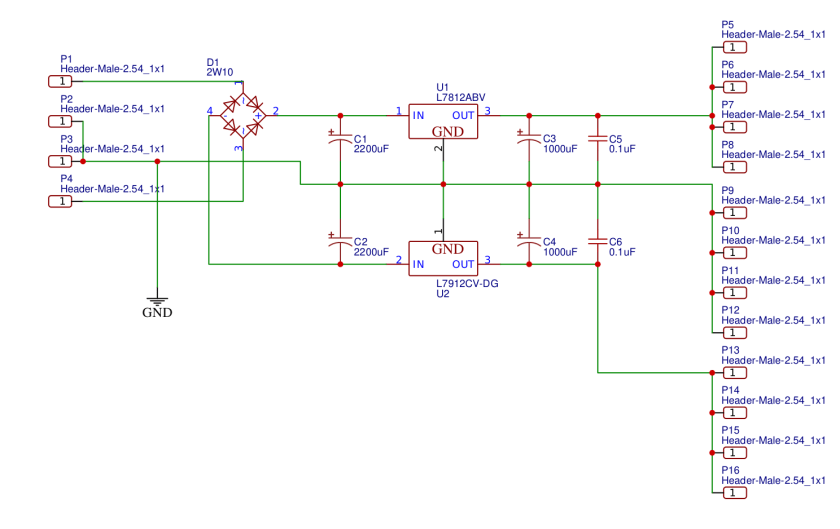
theremin-v2-power-supply

For the new version of the Theremin, I have chosen to use a dual 12V power supply. This will have more flexibility because it will allow me to use more sophisticated units, possibly using op-amps.

The circuit is very basic: it uses a dual 14V transformer (not shown in the schematic) capable of providing 1.5A at its output.

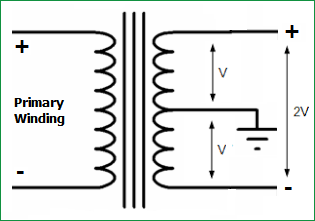
A dual transformer is made up as in the following picture.

center-tapped-transformer

Is has a primary winding that is connected to the AC power supply outlet, and a secondary winding with a center tapped wire that is usually put to ground on the low voltage circuit side.

Voltage between either end wire of the secondary and the center tapped wire is usually the same (with the exception of specifically made transformers), which we call V.

The voltage measured between the two end wires of the winding is instead two times V or 2V.

Sometimes, instead of having a single secondary winding, we have two, carrying the exact same voltage. In this case, we can connect together the two closest wires and consider that as the center tapped wire. Then everything works as the first kind of transformer.

transformer-trans64

The AC current of the transformer is converted in to a DC current through the usage of a bridge rectifier and the capacitors C1 and C2.

The bridge rectifier converts the sine wave coming from the transformer into a fully rectified wave.

Full-wave_rectified_sine

Then, the capacitor that follows (in this case C1 and C2) starts charging over the ascending sides of the wave and discharging, partially, over the descending sides of the wave, basically filling the wave in between crests and making it look like more a straight horizontal line with some disturbance in it that we call ripple (the red line in the following picture).

ripple

In general, depending on the use of the power supply, we define a maximum value of the ripple that the circuit can handle.

In our case, we need to make sure that the voltage at the input of the regulators never goes below 14.5V, according to the data sheet, otherwise the regulator will not function properly.

The peak voltage provided by the transformer is its RMS value multiplied by the square root of 2, or:

peak_voltage

The minimum voltage we can have at the input of the regulator is:

regfulator_input_voltage

This is the max value of ripple that we can sustain.

To calculate the capacitor necessary to obtain this ripple, we use the following formula:

capacitance calculation

where f is the frequency of the alternate current which, in the USA, is 60Hz, and Ix is the maximum current that the power supply needs to provide.

So, we would need a capacitance value, for C1 and C2, of 2358uF.

However, the Theremin circuit will really not draw 1.5A from the power supply, so we can stay a little conservative, and use the closest value below the calculated one, which is 2200uF.

At this point we can safely say that the voltage on the output of the regulators will be exactly 12V (positive or negative, depending on the output side).

To further help the regulator, and preventing the current through it to go too close to the 1.5A threshold, where the regulator would not work anymore because the ripple becomes too high, we add to the output of each regulator another electrolytic capacitor, this one with a value at least equal to the capacitance value that we did not put at the input side. Since at the input side we put a capacitance of 2200uF instead of 2358uF, we will need a capacitor of at least 158uF.

However, to stay totally safe, I decided to use a capacitor at least 5 times higher, so I used the value of 1000uF for C3 and C4.

And finally, I added an extra capacitor (C5 and C6) to shunt toward ground any RF frequency that would travel back from the Theremin oscillators toward the power supply. A 0.1uF value is what is suggested by the data sheet of the regulator, so I used just that.

Why did I use this capacitor if there was already a 1000uF in there?

The reason hides in the way the electrolytic capacitors behave. In short, the electrolytic capacitors do not work well at high frequencies, so we need to add the extra 0.1uF capacitor, which is not an electrolytic one, to work in that range of frequencies. And since the range of frequencies is much higher than the one of the 110Vac outlet, a very small capacitance is enough to do the job.


More on the Theremin: The Heterodyne Mixer

The heterodyne mixer is the stage of the Theremin where the high frequency signals coming from the pitch reference oscillator and the pitch variable oscillator are combined together to obtain the audio signal.

mixer

Here we are again with another post about the Theremin, which can be considered the first electronic musical instrument ever invented, almost 100 years ago, in 1919, by the Russian physicist Leon Theremin.

At that time the Theremin was made out of thermionic valves and used a lot of space and electric power.

theremin_in_concert

Today, thanks to the evolution of electronics in the last century, we can make one that can occupy much less space while also consuming much less power. In fact, this is one of several articles that I have already published on the design and construction of such musical instruments, using solid state components.

Please consult this site archives for the previous articles on the subject and THIS link for schematics and diagrams, which I keep updating as I go in designing and building the pieces of the instrument

A corresponding series on the Theremin is also available on YouTube at THIS link. There, I describe every detail of my project, explaining how the various parts of the device work and how I built everything so far in a very inexpensive way.

In this article I will explore the Mixer stage of the Theremin, describing how it works and how it is used within the Theremin itself.

The mixer is the Theremin stage that combines together the signals from the pitch variable oscillator and the pitch reference oscillator, to create an audio signal that is essentially the sound that the Theremin produces.

The combination of the two input signals is done with a process called heterodyne. It basically consists in multiplying the two input signals by exploiting the non-linear characteristic of transistor Q1, which is carefully polarized outside its linear zone. The result of the multiplication is a new complex signal containing frequencies that are the sum and the difference of the frequencies of the original input signals. Since the frequencies of those input signals are close to each other, their difference falls in the audible range, which is what produces the peculiar sound of the instrument.

Looking at the schematic, you can see that the two input signals are mixed together at the base of transistor Q1, which they reach passing through capacitors C4 and C8, used to decouple the mixer from the direct current superimposed to the input signals.

Transistor Q1 is polarized in the non-linear zone of its characteristics. Because of the non-linearity of the transistor, the two signals end up being multiplied with each other, producing a new, more complex, signal that contains both the sum and the difference of the frequencies of the input signals. This heterodyne process, therefore, applies the following equation to the two input signals:

sin(2πf1t) * sin(2πf2t) = 1/2 cos(2πf1t – 2πf2t) – 1/2 cos(2πf1t + 2πf2t)

where the factors on the left side represent the two sinusoidal input signals, and the resulting complex signal is on the right side of the equation. The above formula is actually a simplification, because it does not take into account the phase shift between the two input signals, which should appear as a phase factor in the parameters of each of the sine waves on the left side of the equation. However, if we did the full calculations, we would see that we would still obtain the same output waves, but each would have an extra amplitude factor that depends on the initial amplitude of the input signals and on their phase shifts.

Anyway, the complex signal obtained at the collector of transistor Q1 is supplied to a Low Pass filter, made up of the components R4, R7, R8, R9, C2, C3, C5, C6 and C7. The filter produces an attenuation of the high frequency element of the complex signal, effectively leaving only the one at low frequency  cos(2πf1t – 2πf2t), which is the audio signal.

That output signal is then passed to the next stage of the Theremin, the VCA, where it acquires the dynamics of the music sound. We will talk about the VCA in a future post.

If you are interested in more information on the Theremin Mixer and how I built it, please watch this companion VIDEO on YouTube.

And, as always,

Happy experiments !!!